Tuesday, March 10, 2015

#71 Feb 2015 Gulfport and Biloxi, Mississippi

Who remembers how to spell MISSISSIPPI? That rhyme was going through my head for days.

Gulfport and Biloxi are side by side on the Gulf of Mexico with incredibly white beaches.

All along the Gulf Coast many buildings are on stilts.

The marinas are full and waiting for warm weather and March spring break. The hordes are coming.

In August 2005 Hurricane Katrina pummeled the Gulf Coast of the US. The media coverage was most dramatic in New Orleans because of the loss of life due to the catastrophic failure of the levee system. Other coastal cities received less attention and assistance but more property damage.

As in New Orleans most of the damage has been demolished or repaired. The tourist information centre in Biloxi is a beautiful southern mansion but is only three years old. The original building was completely destroyed by the Hurricane but has been meticulously recreated from photos and local recollections.

This lighthouse has stood tall for over 160 years of hurricanes. Now it's in the middle of a highway and still sends its beacon out to the Gulf of Mexico.


There was a great deal of criticism about the response from various government agencies at the time of the crisis. Many new laws have been implemented and hopefully coastal communities will be better prepared when, not if, another hurricane strikes.

As we drove along Highway 90 in Gulfport and Biloxi we admired the white sand beach and the inviting water. Initially we did not pay attention to the other side of the road because there is very little to notice. After visiting the information centre we realized why. The beautiful beachfront homes were destroyed or severely damaged by Katrina.

Now beautiful old trees have recovered but no buildings surround them.

New building codes discourage rebuilding on the waterfront and insurance coverage is not available. For sales signs dot the streets.

For Rent? Only the foundations remain.

No buildings attract customers to this parking lot.

The citizens of Biloxi and Gulfport have survived and recovered from many storms and Hurricane Katrina’s damage is no exception. Biloxi is a gambling destination and the tourists are back for the entertainment and beaches.


Ralph and I are not water people. We enjoy being near and on the water but not in it, however, we had to put our feet into the Gulf of Mexico while we were there.

The sand really is as white as this photo.

Monday, March 9, 2015

#70 Feb 2015 New Orleans, Louisiana

As we planned our trip around the US we wanted to remember each state individually. New Orleans is such a familiar name that I didn’t even think about the fact that it's in Louisiana. Now I have the connection.

We took a city tour of New Orleans and glimpsed a few facets of the city through the eyes of a retired teacher who knows and loves his city.

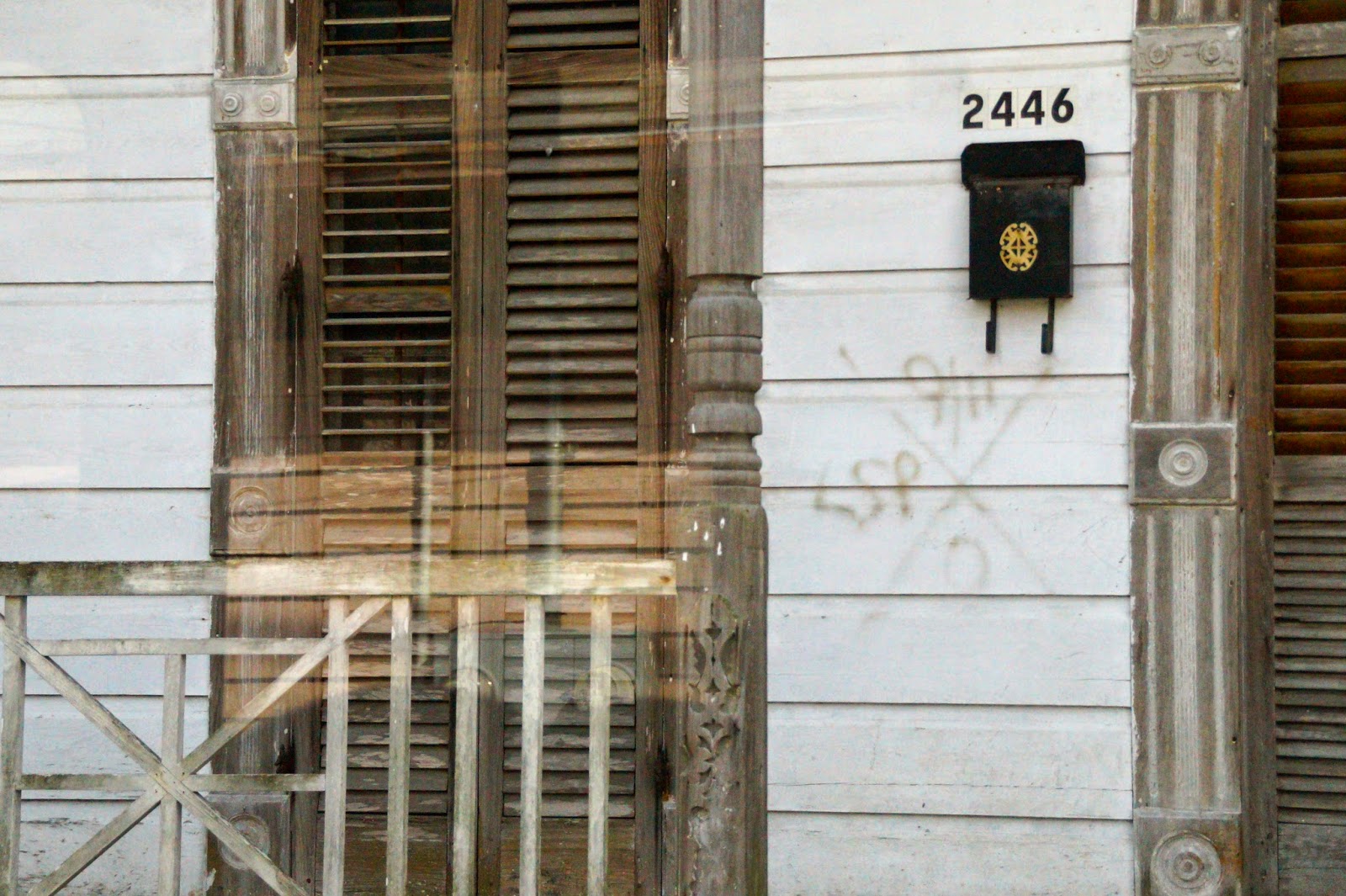
Much of the damage from Hurricane Katrina has been demolished or repaired. This home is one of a few where, just below the mailbox, the marks from the rescue team still show.

This magnolia provides a sense of hope for the future. Life prevails.

A shotgun house is typically 12 feet wide with rooms arranged behind each other and doors at each end of the house. There are archways between rooms which allows the breeze to flow through when the doors are open. Both of these are under repair from the Hurricane damage.


This Greek Revival Home has been renovated and cherished by its owners.


The French, Spanish and English have influenced New Orleans architecture for more than 300 years. The homes of the slaves were also distinctive. This photo through the bus window shows the slave quarters where the roofline always sloped towards the slave owner’s house.


Cemeteries in New Orleans are a popular tourist destination but many of them are crowded and it is difficult to get a sense of them. Our tour stopped at St Roch’s and we were able to respectfully understand the different styles of burial. The tombs may be used for many generations of a family.


The family has not maintained this tomb.


This sign explains the maintenance of the plots and tombs.


Originally all graves were above ground due to the ground water level. Now they may be buried underground such as this row with a new mound which has not yet settled.


The French Quarter is the heart of New Orleans.

The balconies with flower boxes

The music legends

The street musicians

Jackson Square and St Louis Cathedral

The street art

Bourbon Street

You don’t see these scenes anywhere else. Everyone needs to experience New Orleans at least once.


Sunday, March 1, 2015

#69 Feb 2015 New Orleans Mardi Gras!

We had many questions about the total Mardi Gras event and now have some insights.

Mardi Gras starts with Epiphany on January 6th and runs until Shrove Tuesday / Fat Tuesday / Mardi Gras day which is the day before Lent. Lent is 40 days before Easter so the duration of Mardi Gras changes each year.

The first parade in New Orleans was in 1857 with 2 floats by a “krewe” of 6 people assisted by 52 locals. The City of New Orleans now sanctions over 50 krewes, which is the name adopted for Mardi Gras parade groups. They are not for profit organizations whose only purpose is to host a parade and an official party during Mardi Gras. Every krewe is scrutinized by the city. The riders on the floats must be in costume with a full mask, hence, the very fanciful masks everywhere in the city.

Rex, the king of Mardi Gras, and his queen are the only people not masked during the parade.

The floats are owned by each crew and decorated by “Mardi Gras World” which has several warehouses around the city and internationally. We toured their warehouse and gained insight into the floats and parades.

We were fortunate to see the 2015 floats for Orpheus Krewe as they had not started to dismantle the decorations. The basic structures are reused each year.

Each krewe sets a theme for their parade and conveys their ideas to Mardi Gras World, which starts work on the floats the day after Mardi Gras. Each float is an artistic, engineering marvel. Overhead street lights limit the height.

The riders are secured onto the float by anchors such as the one by Ralph’s elbow. During the parade many people get overexcited and grab for throws.

Floats must be towed by a tractor such as this one, which has been enhanced to handle floats that may be seven or eight units long. There may be 30 people on each unit and they bring aboard up to 300 pounds of throws. Some floats have two levels of participants.

Floats can also be human, mule or horse drawn.

Dress up is encouraged during the tour.

Decorations were originally made from wire and paper Mache. Now they are constructed from styrofoam or fiberglass and covered with paper Mache, then painted. They may be changed and reused many times.


This is just over half the length of the warehouse full of floats from one krewe.

Another year we hope to return to experience Mardi Gras in New Orleans knowing what to expect.


#68 Feb 2015 Beginning the New Orleans Experience

When we realized our traveling would bring us to Louisiana during Mardi Gras we had mixed feelings. We had heard many stories about safety and security during the festivities. We chose an RV park an hour from New Orleans on the north side of Lake Pontchartrain.

This is the park in Robert LA. I’m sure it's a hive of activity in the summer.

There are two routes into New Orleans from the north shore of the lake. Going around the lake takes a few minutes longer but is along the swamps and bayous edging the lake.

The causeway across the lake is 24 miles long and is the longest bridge across open water in the world. There are six crossovers and one drawbridge for ships. There is a $3 toll going south into New Orleans with a view of downtown buildings.

We saw more signs of oil activity.

Heading north there is no toll going into smaller cities.

We both had colds so searched out a small, local parade in Covington on Mardi Gras day. Audience participation is expected.

It was just above freezing and windy so everyone was well bundled.


A marching band is a must.

As well as community organizations.

This krewe created the full Mardi Gras float.

The “throws” are loaded onto pegs for easy reaching.