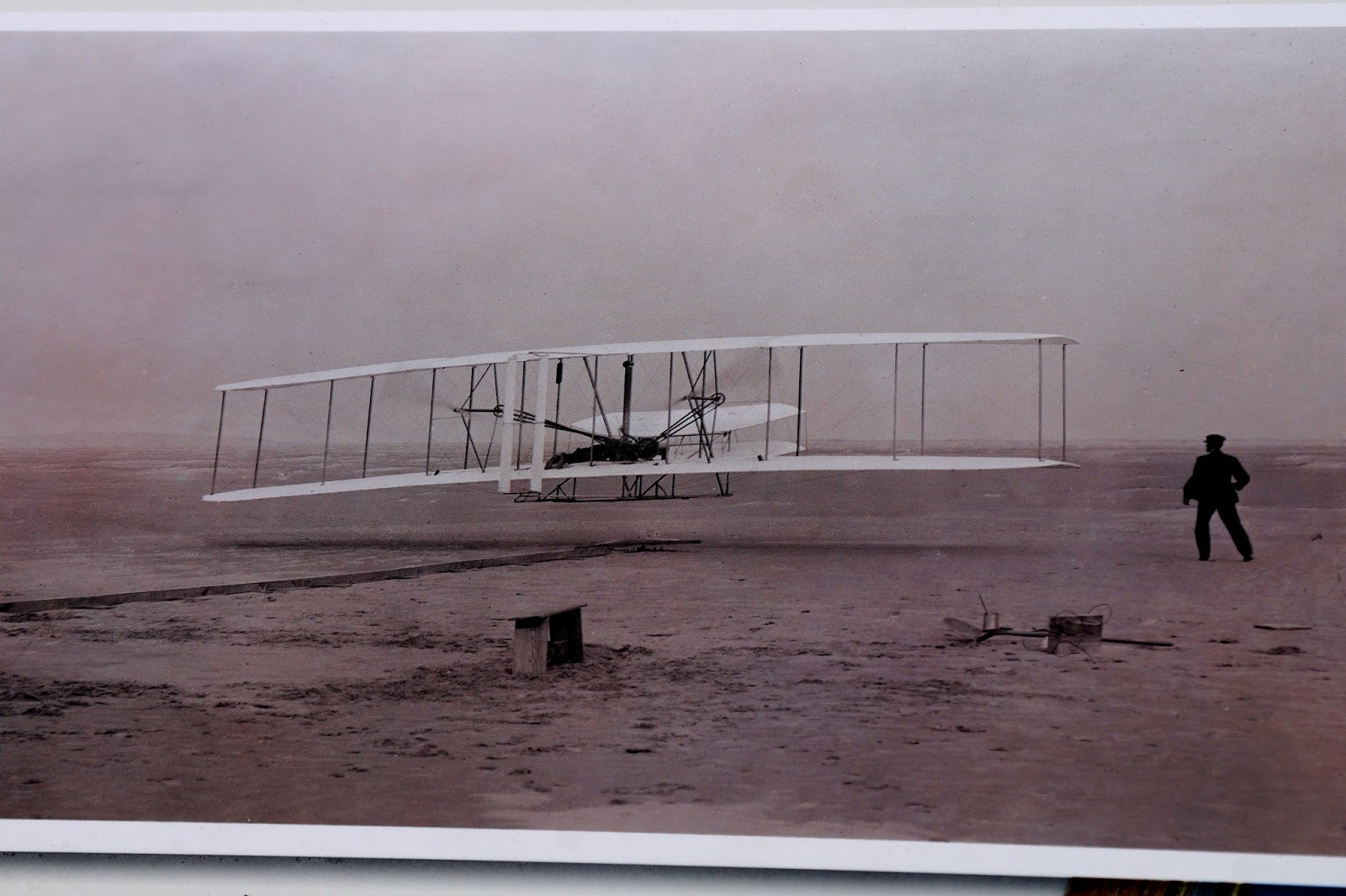
“In 1903 the Wright brothers built and flew the first airplane.”
Aircraft are so much a part of our world today that I've never wondered about the significance of that statement. What led to that achievement?
In 1892, in Dayton Ohio, Wilbur and Orville Wright opened a bicycle repair shop.
Their business prospered but the men were restless. The Smithsonian was funding attempts at human flight. Europeans were experimenting with gliders, balloons and other creations but nothing was working.
In 1899 the Wright brothers realized they had as much chance as anyone at being the first humans to fly. They reviewed others mistakes and applied many of the principals of bicycle motion.
Both men combined intuitive mechanical ability with analytical intelligence. They looked at the problem with an open mind and did not try to manipulate current scientific theories to fit preconceived ideas. They watched the mechanics of birds of prey in flight. How did turkey vultures soar for extended periods of time?
To test their theories they wanted an open space with privacy, a normally windy location, hills (to conduct glider tests), flat land (for actual flights) and sand (for a soft landing).
On the Outer Banks of North Carolina, near the town of Kitty Hawk, Kill Devil Hills fit the criteria. The origin of the name Kill Devil Hills is uncertain but theories include pirates, shipwrecked buccaneers and barrels of rum strong enough to “kill the devil”.
This photo is from the top of the Hill (sand dune) which has been stabilized as part of the historical site.
In 1900 the Wrights went to Kitty Hawk to test their theories. They returned to Ohio for the winter months and reviewed their successes and failures. They continued this schedule with thousands of glider flights during 1901, 1902 and into December 1903. At that time they were discouraged with their progress and the weather was becoming a problem. They persevered for one more day and THEY WERE OFF!
The left of this photo shows the starting point of the flights on December 17, 1903. They improved their control of the aircraft four times that day and flew:
120 feet in 12 seconds
175 feet in 12 seconds
200 feet in 15 seconds, and an amazing
852 feet in 59 seconds (this monument is beyond the right side of the photo)
It took thousands of years until two brothers flew for 12 seconds.
They proved that "impossible" is just something that has not been figured out.
This is a reproduction of the first successful aircraft in the history of the world in which a machine carrying a man had;
Raised itself by its own power into full flight,
Sailed forward without reduction of speed,
Landed at a point as high as that from which it had started.
This life sized playground version of the Wright’s aircraft allows everyone to experience the thrill of that first flight.
The Wrights wanted privacy for their experiments but only a few local people were on hand when they successfully took flight. Fortunately one man was behind a preset camera and recorded the historic event.
Their next step was to show the world what they had accomplished. No one believed they had overcome all the obstacles to human powered flight. They were not willing to demonstrate their achievement without a contract. The brothers improved their machine in private until 1908 when they had a contract with the US Army and France.
Orville performed test flights in Fort Myers, Virginia.
At the same time Wilbur demonstrated the airplane in France.
From that time forward human travel changed dramatically.
In 1969, only 66 years later, man walked on the moon.
In 1998, only 95 years later, construction of the International Space Station began. Since 2000, astronauts from fifteen countries have continuously occupied it.
In 1928 a memorial dedicated to the beginning of aviation was begun. It was a much grander undertaking than expected and was not completed until 1932.
In 2003 a century of aviation was celebrated by more than 120,000 people.
Man to Mars is next, perhaps using this prototype rover!