Thursday, March 1, 2018

#164 Oct 2017 Exploring Around Sedona

The countryside around Sedona varies dramatically from extinct volcanoes to native pueblos and historic railroads.

Sunset Crater Volcano is the youngest of many volcanoes in the San Francisco Volcano Field. Erupting less than 1,000 years ago this cinder cone formed when basalt magma rose directly to the surface through a primary vent. Pressure blasted the lava into pieces, which cooled in flight and piled into this cone-shaped hill.


The Sunset Crater eruption covered more than 800 square miles (2,071 sq. km) in volcanic cinder and ash.


The lava field is accessible but rough walking.


Slowly soil is formed and a succession of plant adapt to this volcanic environment.


About 900 years ago Wupatki Pueblo with about 100 rooms was built on the outer limits of Sunset Crater Volcano lava flow. The village became the heart of a thriving community and was a landmark, a gathering place and a ceremonial centre.


The excavated walls begin to show the shape of the buildings.


Builders took advantage of natural features.


During celebrations men and boys engaged in contests in the ball court.


Ongoing archeological exploration will reveal more insight into the life and activities of the Hopi and Zuni people.


We explored more recent history on the Verde Canyon Railroad. The train meanders from nearby Clarkdale along the Verde River Valley.


Red rock continues to fascinate us.


Including Turtle Rock.


At the ghost town of Perkinsville the engine switches train ends and heads back to Clarkdale.


Ranching and copper mining shaped the area.


Tunnels, close rock walls and old trestles add to the adventure.


Sunday, February 25, 2018

#163 Oct 2017 Sedona - So Much to See!

Ralph and I planned this trip for a couple of reasons.

Firstly we had timeshare points to use. A dishwasher and no beds to make!

Secondly we planned to stay in Surrey for the winter so wanted some heat and sunshine beforehand.

Our time in Indio was leisurely and relaxing. We explored new places but also had quiet time.

Our next destination was Sedona Arizona. In January 2014 we spent time in that area and knew there was so much more to see and do. Our blogs #13, #14 and #15 cover our experiences at that time. Now it was time for more explorations.

When possible we take a city tour to get acquainted with an area. This time it was Red Rock Magic Trolley. The red rocks defy description. Around every turn is another spectacular view.


Even the roadside is beautiful.


Many celebrities have built homes in Sedona.  Note the mannequin of Lucille Ball complete with her trademark red hair.


Chapel of the Holy Cross is always worth a visit.


The city building code restricts the architecture, height and colour of all buildings in order to maintain the continuity of the view.


Even McDonald’s had to change the colour of the M.


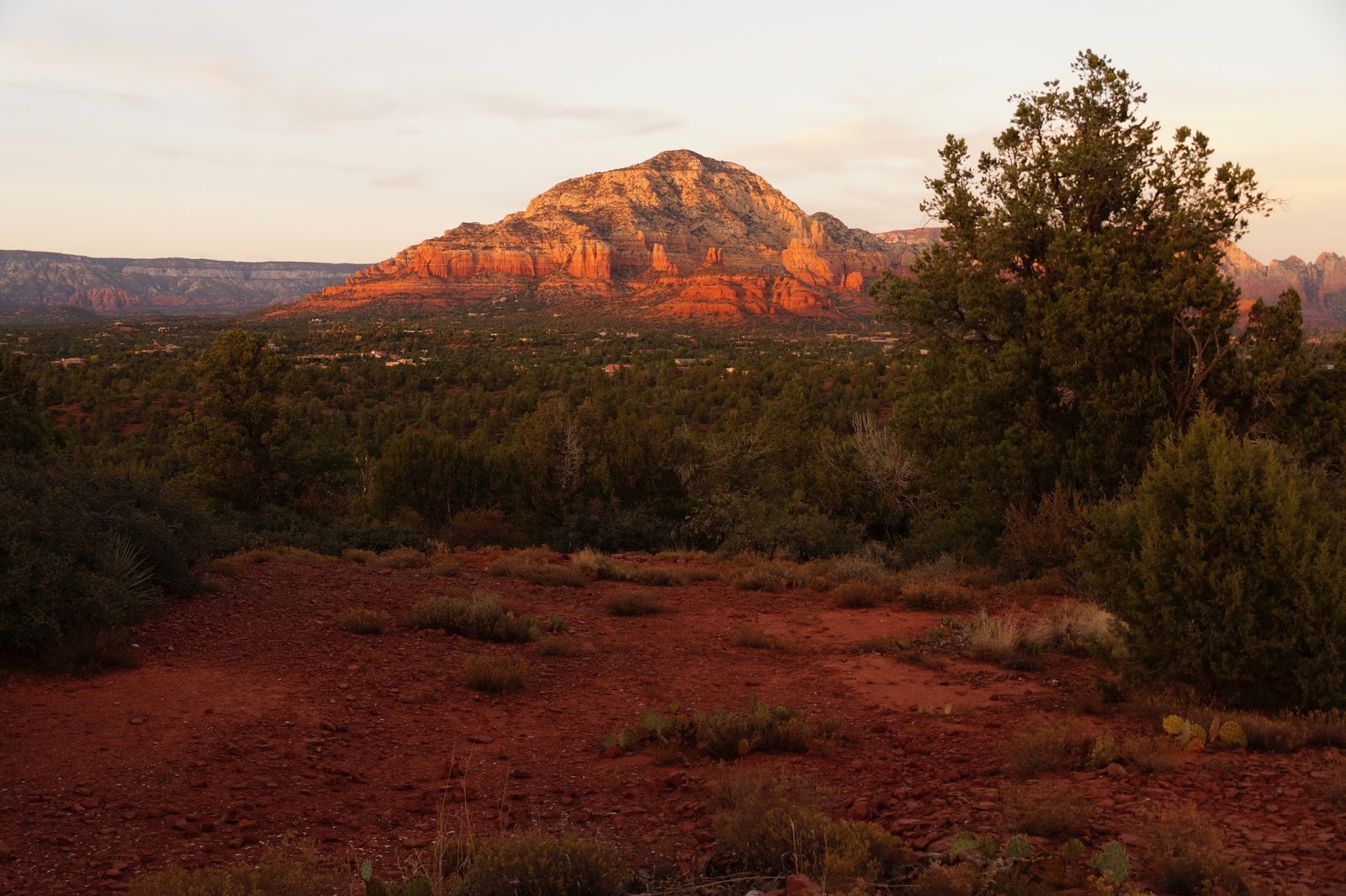
Sunsets are never ending as shadows move across the valley.


Just as the sun disappears the evening star can be seen.


Jet trails are a small reminder that the rest of the world is out there somewhere but we are immersed in the beauty of nature.


Saturday, February 24, 2018

#162A Oct 2017 Anyone for a Date?

                                                    That is, a fresh date to munch on!


Dates have been cultivated in the Middle East for over 5,000 years and are mentioned in the Bible, the Torah and the Qur’an. They are a sweet, nutritious delicacy integral to Eastern diets and cultural traditions.


The Coachella Valley is the primary date growing region in North America. The life cycle of the date palm is unusual and fascinating.

Date farming is a year round operation requiring skilled workers.


Just as every time a child is born a new, different person is brought into the world, date seeds do not create an identical new tree. Nature has never repeated people nor has she repeated dates grown from seeds.

Male and female date palms produce offshoots of their own sex, which will be identical to their ancestors. These offshoots are removed from the parent tree and transplanted in order to maintain the same variety and quality of fruit.


“A date palm must have its feet in the water and it head in the fires of Heaven” is an old world saying. It requires as much water as a willow tree but only at its roots.

Date palms have 4 to 5 inch thorns, which are removed from the trees in January and February.


New palms are planted at 48 females to one male per acre. Full fruit production will not be reached until 10 to 15 years after planting.


Nature did not make date flowers appealing to birds so workers manually pollinate each female blossom.


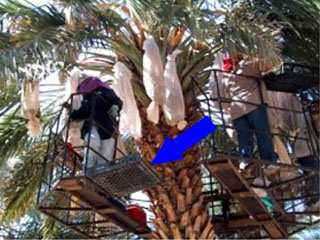
In July the date bunches are covered with cloth or paper bags to protect them from rain and birds. The bags also collect early ripening dates before they fall to the ground.


Depending upon the moisture content of the date varieties they are harvested mechanically or by hand from August to Christmas. Manual harvesting is conducted by ladders attached to the trees or with a U shaped basket on a forklift.


Harvest time can be extremely hot. Workers wear protective gear to shield them from the heat and the thorns.


When the palms become too tall for safe harvesting the farms are abandoned.


We have always enjoyed eating dates but now we have a greater appreciation of growing the most expensive crop in the world.